Blackball Pear

In a valley near the town of Blackball on the West Coast, there lies an unusual pear tree. It is literally lying there, as it blew over a few years ago in a storm. I’m not sure how old this pear tree is, but I would estimate at least 80 years old as a conservative estimate, but quite possibly substantially older due to the relatively poor soils at the site and the fact it was probably left to fend for itself for most of its life while bush regrew around it.

The current owner of the pear tree said the site was old Chinese mining tailings. It’s worth exploring this aspect a little bit I think as it could possibly be important context.

Chinese gold miners first began to arrive for the West Coast gold rush in 1867, and by the mid 1870s there were a few thousand Chinese gold miners on the West Coast goldfields. They were often treated poorly by Europeans and were usually only allowed to mine claims considered uneconomic or worked out, as well as often ‘encouraged’ to live outside of the European townships. Not all Chinese arrivals came to mine – many were also market gardeners, merchants or launderers. Most intended to return home after making their fortunes. Chinese miners were still a large presence in Blackball by 1890, probably being the largest group of the approximately 100 residents at that time. In 1893 the first coal mine opened near Blackball and continued for a number of decades, presumably with some Chinese miners working the coal seams. So there was a fairly substantial Chinese presence in Blackball for a number of decades.

To be clear, I haven’t been able to figure out if the origin of the pear tree coincides with the period of active Chinese gold mining, or whether it was planted much later, but it is interesting to ponder whether there could be a Chinese connection.

The fruit of the Blackball pear are described by the owner as being a small but otherwise classic European pear (Pyrus communis). She said the flesh was sweet and tasty, and I definitely trust her experience to judge this. Unfortunately since the tree blew down a few years ago, it has not yet fruited (although the tree is very much still alive), so I cannot give my own taste report.

The next few pictures show the size of the tree.

The Blackball pear tree, lying down, wife for scale. All of the dark green leaves new growth that has resprouted from the pear.
This image has an empty alt attribute; its file name is image-8.png
Looking up at the two trunks of the Blackball pear tree.

The owner also reported this pear tree to be self-fertile. Now as you may know, almost all pear varieties are self-infertile, and require cross-pollination to set fruit. I mentioned to the owner whether it’s possible that each trunk could be a similar looking but genetically distinct pear so that they appear to be the all one pear, but she didn’t think there were any differences among the fruit. We couldn’t rule the possibility out completely though.

She sprouted some seeds from the fruit (and grew those trees out too) and they seemed fine, so we can confirm that the tree is at least getting pollinated sometimes. The Blackball pear tree is also relatively isolated, and so I would consider it low likelihood that it’s getting pollen from a nearby pear tree.

Some pear varieties are able to set fruit without pollination (parthenocarpy), and that can’t be ruled out either (although as some seeds were fertile and produced varied offspring, it means that parthenocarpy cannot explain all of the fruit).

Most unusually though, this pear has burgundy coloured new growth, something that is very rare in European pear varieties.

Red new growth from the original Blackball pear tree.
Red new growth on my grafted Blackball pear. Notice slight hair on the young leaves as well.

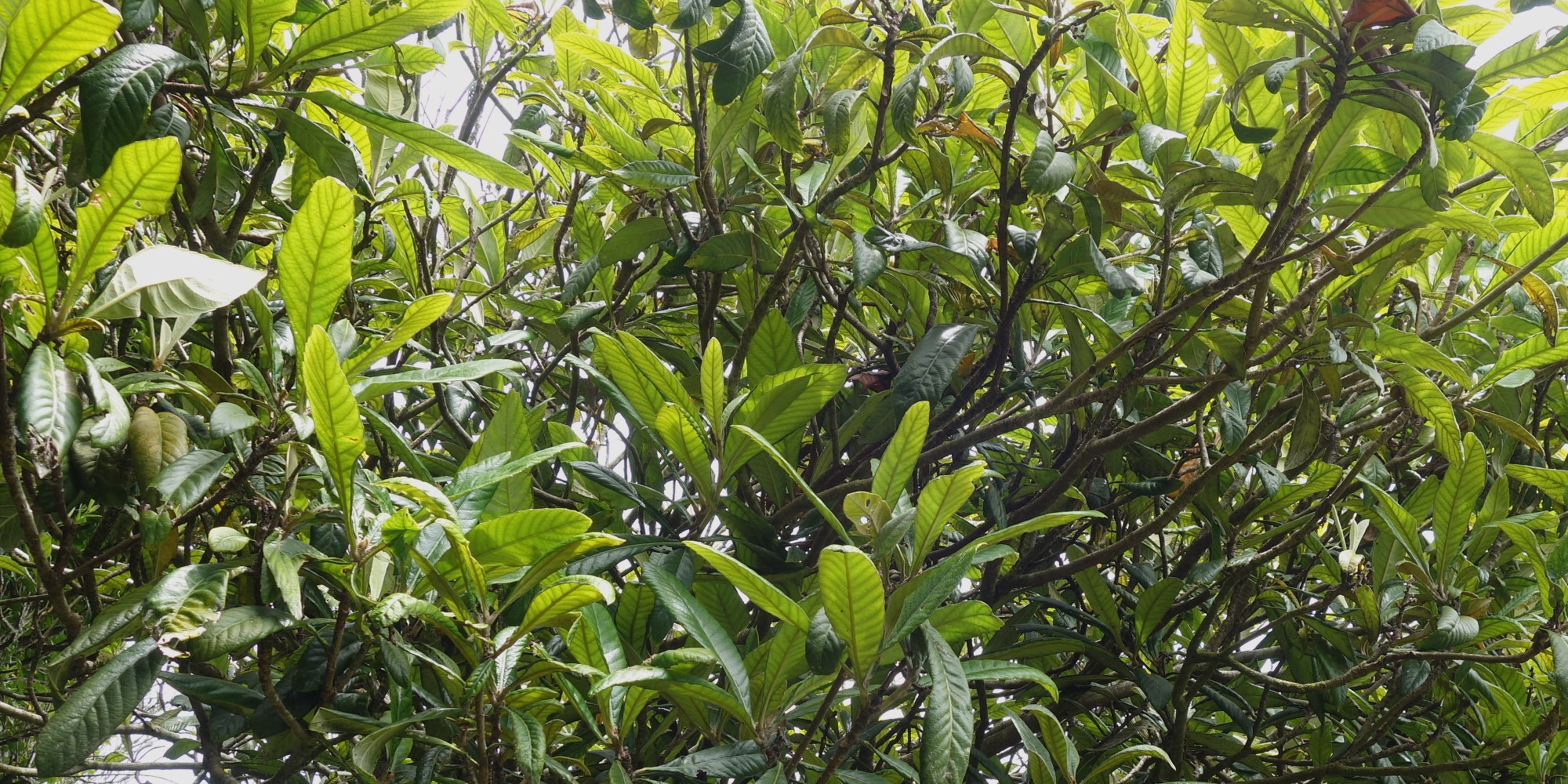
The foliage when grown in shade matures shiny and dark green, and has an ovate leaf blade shape.

Foliage when grown in shade is shiny and not quite as narrow.
Some leaves that are slightly longer.

As I mentioned, there are very few European pears with such dark red new growth, and of those, most are either hybrids with Asian pears (e.g. Chinese white pear (Pyrus x bretschneideri) or are red-fruited sports such as red D’Anjou or red Bartlett sports. As the Blackball pear does not have red fruits, it is thus not a red-fruited sport, and so unlikely to be a pure European pear. There are quite a few European with pale red/orange new growth, e.g. Taylor’s Gold, but there is a large and seemingly empty gulf between those and the burgundy new leaves of the Blackball pear.

I asked two pear genetics experts for assistance in identifying this pear, and they were unable to offer much more than to agree that it very plausible this tree has Asian genetics, and to mention the red-fruited sports of European pears. I asked a friend very knowledgeable with obscure European heritage pears, and he also didn’t know of any varieties with such red leaves and agreed it was probably a hybrid.

So I think the most plausible hypothesis (without any further information, such as genetic testing) is that the Blackball pear has some Asian pear genetics.

It is perhaps possible that this was a seedling pear grown from a discarded European pear fruit bought locally 100~ years ago, that was randomly pollinated by an Asian pear back at the orchard. However my understanding is that Asian pears were few and far between in New Zealand 100~ years ago, and even now with nashis widespread across the country, there are few to no hybrid pears being found.

So perhaps it is more likely that this pear tree came from an existing hybrid pear? It’s worth investigating hybrid pears then to look for similar varieties. There are approximately three eras of hybrids between European pears and Asian pears – the modern era, the recent era and the ancient era – from what I can tell.

The modern era is dominated by the work of the former Plant & Food Research (now merged into the New Zealand Institute for Bioeconomy Science). They embarked on a large breeding program to create interspecific hybrid pears between Asian and European pears. The broad goal for that project is to develop pears with the crisp texture of Asian pears and the aromatic flavour of European pears. The main success of this program to date is PremP009, which is sold under the trade name ‘Piqa Boo’. As the Blackball pear is predates this work by the better part of a century, this era is not directly relevant.

The recent era is dominated by chance hybrids and breeding program selections from the USA from the last three centuries. Fireblight was first observed in the late 18th century in New York. Over the next century, fireblight spread widely and threatened to wipe out all apple and pear cultivation on the East Coast. Asian pears such as the Chinese sand pear (Pyrus pyrifolia), known as nashi in New Zealand, Ussurian pear (Pyrus ussuriensis), and the now infamous Callery pear (Pyrus calleryana) were introduced to the United States to provide fireblight resistant genetics. Chance hybrids between Chinese sand pear and European pear were regularly found during the 19th century, such as ‘Kieffer’, ‘Le Conte’, ‘Pineapple’, ‘Hood’ and ‘Orient’. These tended to be intermediate between the parents, with a more rounded shape and usually crisp flesh. In the 20th century, various universities and the USDA started breeding programs to develop fireblight resistant pears for commercial use. Hybrid pear varieties released include ‘Moonglow’, ‘Magness’, ‘Flordahome’ and more recently ‘Potomac’ and ‘Sunrise’. New releases are slowly being released from these programs, but they are increasingly complex hybrids that have lower contributions from Asian pears.

The ancient era of hybrid pears is the least well understood, and is mostly represented by two pear populations – Pyrus regelli and Fragrant pear (Pyrus x sinkiangensis). Pyrus regelli is an apparently wild pear native to Central Asia, but it’s rare, little known and not cultivated.

Fragrant pear is one of the main cultivated pear types in China, and has long been associated with the Xinjiang region, in the North West of China. The Silk road passed through Xinjiang and so the region was a major trade hub for approximately 1500 years. Fragrant pear is a group of varieties that tends to be somewhat intermediate between European pear and Chinese white pear (Pyrus x bretschneideri), with some varieties having crisp flesh, and others melting flesh. In general the fruits are small sized, yellowish-greenish coloured, and with a characteristically long fruit stalk (pedicel). Sometimes the calyx can be persistent as well. Genetic testing results are conflicting, but results from China indicate that Fragrant pear is descended from cultivated (not wild) European pears, and cultivated Asian pears. Interestingly there is a historical record from about 2000 years ago of a Han dynasty diplomat, bringing over cultivated Asian pears to the Xinjiang region.

When I first read this description and saw the photos, I felt a few sparks fly. Could Fragrant pear be the explanation for the Blackball pear? Could a Chinese gold miner, over a century ago, have brought in some seeds or fruit from China, and long after all of their buildings had fallen down and become earth again, their treasured memento of home is still peacefully growing there?

The general appearance of the fruit and the flesh texture being more towards European, the long stalk, the red new growth, and the Chinese connection. Most of the Chinese miners who came to Blackball were said to have come from Canton, a fair way away from Xinjiang, but maybe it’s still possible?

Fragrant pear (Pyrus x sinkiangensis) fruit that look similar to the Blackball pear.
More fragrant pear fruit.

Well, that is where the story ends for now – with questions and no answers. I will continue to research this pear and the local history, and I hope the answer is as interesting as the research. Regardless, we will propagate this pear locally to ensure that it can still be found here after another century has elapsed.

There is one thing we can roughly deduce from the Blackball pear, and that is by growing a few dozen seedlings we can look for either segregation (grouping into fairly distinct groups of offspring based on appearance), or uniformity. Segregation implies the Blackball pear has high heterozygosity, which means it is likely an F1 or F2 hybrid itself, which points to a more recent origin. If the offspring are uniform, it implies the Blackball pear has high homozygosity, which implies it is a long established genetic line from either a landrace or a species, and thus has an ancient origin.

If you’ve read this far and you know of any heritage pears with burgundy new growth – please do contact me, as that may abruptly end this mystery. And if you know of some very very old heritage pears in New Zealand that you believe have been overlooked, also please get in touch.

References

  • https://researcharchive.lincoln.ac.nz/server/api/core/bitstreams/68f94592-437f-4d5f-a01a-c53b096bee89/content
  • https://shantytown.co.nz/attractions/chinatown/
  • https://www.handsonhistory.co.nz/students/chinese-minners/
  • https://westcoast.recollect.co.nz/nodes/view/30309
  • https://www.plantandfood.com/en-nz/article/evaluating-the-potential-for-genomic-selection-in-interspecific-pear
  • https://digitalcommons.usu.edu/cgi/viewcontent.cgi?article=2861&context=extension_curall
  • https://trace.tennessee.edu/cgi/viewcontent.cgi?referer=&httpsredir=1&article=1167&context=utk_agbulletin
  • https://www.frontiersin.org/journals/plant-science/articles/10.3389/fpls.2024.1474143/full
  • https://content.ces.ncsu.edu/callery-pear-bradford-pear-other-varieties-and-their-invasive-offspring
  • https://cdnc.ucr.edu/?a=d&d=PRP18910124.2.4.2&e=——-en–20–1–txt-txIN——–
  • https://pmc.ncbi.nlm.nih.gov/articles/PMC5996476/
  • https://pmc.ncbi.nlm.nih.gov/articles/PMC7466967/
  • https://www.actahort.org/books/1308/1308_1.htm
  • Korban SS, editor. The Pear Genome. Springer International Publishing; 2019 Jul 3.
  • https://www.asianflora.com/Rosaceae/Pyrus-sinkiangensis.htm

More new Citrus varieties!

We have just imported a large quantity of new Citrus varieties into New Zealand (as seed). These came mostly from an overseas Citrus arboretum, and the import was inspected and approved by MPI.

For almost all of these varieties, it’s the first time they have been available in New Zealand (only Cox and Swingle were already imported previously). The reason we imported these is to increase the Citrus genetic diversity in New Zealand, which is relatively narrow at the moment. Genetic diversity will help us grow more food for ourselves, and give us a better chance to handle diseases and a changing climate. Some of these varieties may also be fantastic Citrus rootstocks for certain regions with challenging conditions, such as the West Coast or inland Canterbury/Otago and central North island.

These Citrus have various usages from eating fresh, for marmalade, for juice and for cooking. Many are ultra cold tolerant (to -15 Celsius).

Almost all of these varieties will will ‘clone’ themselves via seed (weird thing Citrus do called Nucellar embryony – article here). A few will produce very unusual seedlings and there could be the next favourite Citrus variety in those.

Seeds are available here: https://agroforestry.co.nz/product-category/seeds/

List of mostly-new Citrus varieties:
Barkley ichandarin
Zao Yang trifoliate
Swingle citrumelo
Cox citrandarin
Ichang papeda
Knights citron
Indian wild orange
Karna khatta hybrid
Beni Amanatsu
Jeruk limau
Citremon

And another half dozen varieties came in very small quantities and so we will grow those on ourselves, before eventually selling grafted varieties. We will make most of these varieties available as grafted plants in the future, but for now buying these seeds is the only way you will be able to grow them.

Any questions – just ask us!

Very Early Leafing Walnuts

We so far haven’t written much about walnuts, although we have been working with them for a few years. Walnuts are not huge fans of the West Coast climate, to say the least. They prefer hot and dry Summers, and deep and free-draining soils – neither of which are plentiful on the Coast. However the nutrition provided by walnuts is very hard to find in other tree crops, being both high in protein (not too difficult to find in other tree crops) and omega-3 essential fatty acids (good luck finding this in other perennials!), and so we believe that it’s worth persevering, despite the challenges.

On the plus side, our climate is relatively frost-free, and late frosts are rare and usually not severe. So we hypothesize that very early leafing varieties of walnut will give us a longer growing season, which would help counterbalance that our Summers are relatively mild. Most walnut breeding programs around the world typically breed late-leafing varieties to avoid the risk of late Spring frosts.

The other reason most walnut breeding programs aim for late-leafing is avoidance of walnut blight. Wet Spring weather during bud break is the ideal time for walnut blight to spread and take hold, so delaying leafing out by a few weeks can avoid wet Spring weather altogether in continental climates. Susceptible walnuts in a wet Spring can have almost the entire crop lost to blight, so it’s a serious problem. As there’s no guarantee that our West Coast late Spring is any drier than our early Spring (often the opposite!), I suspect that blight avoidance is not a feasible strategy for our region anyway. To this end, we are looking to work with interspecific hybrids to introduce true blight tolerance.

Other countries have access to many wonderful and productive interspecific walnut hybrids, often selected from the best of hundreds of seedlings, however in New Zealand these sorts of hybrids are essentially unheard of, and extremely rare. The few walnut grafters in New Zealand have worked with Paradox hybrids (Juglans hindsii x regia hybrids) for use as rootstock decades ago, but none do any longer. There are a few recorded Juglans ailantifolia x regia trees, but at least one has extremely poor quality nuts (double shell thickness) and I’ve not seen anything from the others.

What we do have in New Zealand though are a few successful hybrids with the iron walnut (Juglans sigillata). The iron walnut is native to the eastern Himalayas and western China, and is the closest relative to Persian walnut, having diverged an estimated 49 million years ago. Nick Nelson Parker has selected at least two apparent sigillata hybrids that are productive nut producers and have vigorous growth (‘Legacy’ and ‘Prolific’).

The seedling below is an open-pollinated seedling of ‘Legacy’, and has been leafing out for over a week now (it was in some shade as well). This is the earliest I’ve seen a walnut leaf out, and is earlier than all of my plums and roughly at the same time as almond and quince.

Open pollinated Juglans sigillata x regia F2 seedling

Of course there’s no guarantee that this seedling will amount to much, but if nobody ever tries, then we’ll never improve upon what we have.

Limited research has shown that Juglans sigillata x regia crosses can apparently have true blight resistance. Two J. sigillata x regia hybrids (in Sassafras, Australia and Guangxi, China) had anomalously low blight measurements in the study. Guangxi region has a warm and wet subtropical climate, with rainfall peaking in summer – sounds similar to the West Coast.

Walnut blight incidence for various walnuts vs rainfall accumulation post bud burst. The Sassafras hybrid and Guangxi hybrid (highlighted with a red triangle and blue circle respectively) are both believed to be J. sigillata x regia and are noticeable outliers from the general trend of wetter weather = more blight. Graph modified from [1].

We have been planting out a mother orchard of varied walnut genetics, to later make some crosses from ourselves. We’re also working on walnut grafting as well, which are one of the more difficult temperate tree crops to graft. The first ‘variety’ we’re attempting to graft is a walnut seedling found in Canterbury that appears to be mostly blight resistant. It was the best by a long shot of approximately 30 walnut trees I inspected during last Summer, with extremely few signs of blight on nuts or leaves, and no shoot dieback. As last Summer was considered extremely wet and poor by Canterbury standards, it was an ideal time to look for blight resistant walnut trees.

Lastly, we are always interested in hearing more about interspecific walnut hybrids already in New Zealand, or if you think you have seen a particularly unusual or blight tolerant walnut please let us know 🙂

References

  1. McNeil, D.L. (2016). Walnut blight disease development on Guangxi walnuts. Acta Hortic. 1109, 261-264
    DOI: 10.17660/ActaHortic.2016.1109.42
    https://doi.org/10.17660/ActaHortic.2016.1109.42

Second Bunch of Bananas Ripened

Our 2nd bunch of bananas is ripe now, after ripening the last few weeks inside. The banana stem had snapped and fallen over a few weeks ago. Probably because I haven’t had enough time to maintain that patch, such as weeding. Weeds at the base area can cause it to remain damp for too long, leading to rot problems.

I wasn’t sure this bunch would ripen inside, but it has. They are creamy, sweet and taste similar to a slightly-green supermarket banana. These are from a Pisang Awak variety (originally from Auckland Botanic Gardens via one of their plant sales).

This banana patch received no protection or anything, just good soil and a good planting site with surrounding plants sheltering against wind.

Ripe Pisang Awak bunch
Pisang Awak banana bunch on the ground 🙁

Citrus Update July 2025

Well we are finally sold out of Alemow and Furr C-57 seeds, a huge thank you to everyone who bought some seeds and is helping to trial them in New Zealand. We couldn’t do these kinds of things without your support, so thank you.

Seedlings from our first test batch. Furr C-57 in the top pots, Alemow in the bottom. A slug got into the right-hand Alemow pot hence the smaller size.

We have also finished compiling all the information we can find about these varieties into ‘comprehensive’ plant profiles. Please give them a read if you’re interested in Alemow or Furr C-57 to get the latest up to date information.

If I had to pick 3 key things to mention:

  • Genetic testing has shown that Alemow is actually a papeda x citron (same cross as Mexican / Key lime), and not a papeda x pomelo as is commonly reported, and so Alemow is actually a true giant lime
  • Alemow is very susceptible to Citrus Tristeza Virus [CTV], and so it’s recommended to graft it with CTV resistant scions such as lemons, trifoliata and hybrids, Meiwa, Etrog-type citrons, rough lemons, rangpurs (partial list of CTV resistant varieties in the plant profile).
  • Furr C-57 seems to actually taste pretty good for a trifoliata F1 hybrid, with nearly top marks from a taste report.

Last and definitely not least, we apparently didn’t get enough chaos from importing Citrus seeds, and so we decided to do it again!! This time an incredibly special opportunity was presented to us to import rare and genetically distinct Citrus, and so even more special Citrus seeds are on the way. We’re very excited to share more once everything is final. 🙂

Superlate Apples

Apples that hang on the tree well into July (at least) while still retaining great eating quality are what I’d describe as ‘superlate’ apples. Other people have called them ‘Long keeping apples‘ (but I think that is a misleading name as usually ‘keeping’ / ‘keeper’ usually refers to storage off-tree). I think these traits are important for food security, as these days relatively few houses have the space to store apples in a cool and dry place. Plus who doesn’t love physically picking apples in July.

So far I’d never come across any roadside apples that I’d describe as superlate until this one. I found this apple somewhat hidden in Weka Pass 2 days ago, still holding a decent crop of apples (more than in the photo). The tree is on a fenceline by itself, so I’m pretty sure it’s a seedling.

These apples are completely crunchy and juicy, no dryness or flouriness. In fact, some of the apples were still not fully ripe! I would describe the flavour as being slightly tart and lower-medium sweetness. On the spectrum between a Gala/Braeburn and Granny Smith, this one would be roughly 1/4 – 1/2 of the way towards Granny Smith (maybe it’s a Granny Smith seedling? As Granny Smith is also known to store on the tree very late).

These apples I think could hang on the tree another 2-3 weeks, but also the birds were getting into them so maybe by then they’d all be pecked through.

Very keen to hear about what other apple varieties folks have or know about that are still hanging on the tree 🙂

The tree still holding a crop (only about half or so of the apples are visible)

Ancient Egyptians, Greeks and Romans Ate Taro

One of the most astounding facts that I’ve ever learned is that taro is not just a crop of the Asia-Pacific region, but has about two thousand years of history as a food crop in the Mediterranean.

It seems almost anachronistic to me, as if someone had told me the Ancient Egyptians liked to go surfing. In one sense, we could even say that taro is more traditionally Italian than tomatoes!

This article will take a look at this topic, and spoiler: perhaps this ancient taro is not just ancient history: https://agroforestry.co.nz/ancient-egyptians-greeks-and-romans-ate-taro/

Torreya nucifera var igaensis in New Zealand (?)

Recently I was kindly sent some extra Torreya seeds collected from trees labelled Torreya nucifera in the North island by a friend. Initially I was very doubtful of the identification, as the size of the seeds was vastly different to the other Torreya nucifera seeds I have received.

Clockwise from top left 1) North Island Torreya fruits 2) North island Torreya nuts 3) Torreya nucifera seeds from Austria 4) Torreya californica seeds from California

However the Gymnosperm Database in its description for Torreya nucifera has this enigmatic paragraph [1]:

Ohwi (1965) recognizes a number of varieties, which are not mentioned by Farjon (2010). Var. radicans is shrubby, native to the Honshu mountains. Var. macrosperma has a large seed 35-40 mm long, and is found only in the Mie and Shiga prefectures on Honshu. Var. igaensis has shorter (10-18 mm long), abruptly spinescent leaves, with a short (20 mm) seed. It is rare, found only in Iga Prefecture on Honshu.

The $2 coin has a diameter of 26.5mm, so perhaps the seeds are from Torreya nucifera var igaensis. The seeds from Austria look to be about 35mm long which matches Torreya nucifera var macrosperma.

Close up photo showing seeds as well as the single leaf blade that came with the seeds. The length of the leaf blade matches the description for igaensis.

Since we’re selecting for larger seeds, there may not appear to be any benefit to selecting this variety with smaller seeds. However it’s always worth growing out extra genetics if you have the space, as it’s possible that the smaller seed size is offset with vigour, precociousness or productiveness.

Hopefully we’ll be able to plant out a trial row of Torreya within the next 1-2 years and begin the next phase of our Torreya project.

References

  1. https://www.conifers.org/ta/Torreya_nucifera.php

Join Waitlist We will inform you when the product arrives in stock. Please leave your valid email address below.